
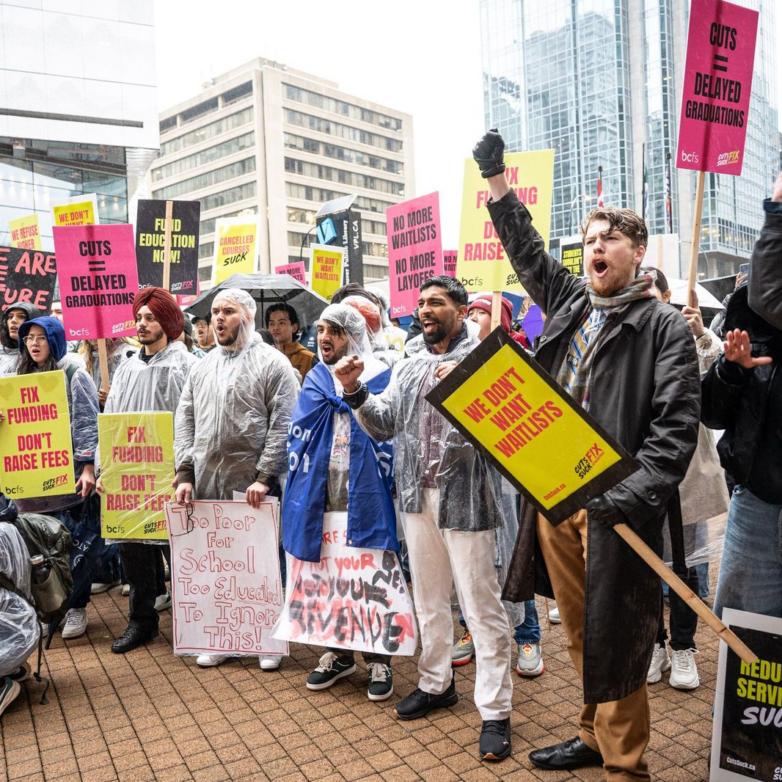
As VCC projects a significant budget deficit, affecting programs, staffing, student services, and international fees, we face no relief from the provincial budget.
Finance Minister Brenda Bailey announced BC’s priorities: “Protect and improve core public services people rely on, like health care and education.” Yet increased funding for Post-Secondary Institutions is mysteriously missing from the 2026 Budget. Today, public funding for Post-Secondary Education remains at a stagnant 40%, a significant drop from 68% in 2000. With a projected 2026/2027 provincial deficit of $13.3 Billion, and no mention of prioritizing Post-Secondary Institutions, we are cautiously awaiting the consequences.
PSIs have long been bridging the gap between provincial funding and domestic tuition with un-capped international tuition fees. Relying on exorbitant international tuition is not a reliable nor sustainable funding model. This became starkly apparent in the past year, when international student enrollment dropped 37% due to federal reduction in study permits. The result is millions of dollars of lost revenue and significant budget deficits. Without an increase in provincial funding, institutions are forced to reduce costs through staff and faculty layoffs, reduction of student services, axing of programs, and increased international fees.
VCC is unique in the accessible and community-serving programs it offers. Underrepresented populations are served through Adult Basic Education, ASL and Sign Language Interpreter training, and programs for the Deaf and Hard of Hearing, Visually Impaired, and folks with cognitive disabilities. These programs that directly benefit and help build a more equitable community are expensive to run, and often not revenue-generating. What will happen to the viability of these critical programs as VCC struggles with an increasing deficit?
VCC Students have expressed concerns about what would happen if tuition prices were to increase, including food insecurity and mental health concerns. Students would consider taking on more debt, moving to another province or country, delaying graduation, and even dropping out of school. For citizens of BC, this would mean less skilled workers, labor shortages, and more personal debt.
As cost-of-living rises in BC, students can’t afford to pay more for their education while their institutions have less to offer. Students have the power to use their voice to demand a better, more affordable education. Thousands of students across the province are standing up against these budget cuts through the BCFS “Cuts Suck, Fix Education” campaign.
“Tuition prices suck. Cancelled courses suck. Staff layoffs suck. Reduced services suck.
We are paying more and getting less.
BC’s students deserve better.”
Take Action!
Fill out a quick form to tell the BC government to reinvest in our schools!